

Los Angeles Shows That Homelessness Can Be Reduced Through Visionary Governance
Inside Safe Programme: How Los Angeles Is Rebuilding Its Reputation One Encampment at a Time with Visionary Governance® in Public Policy.
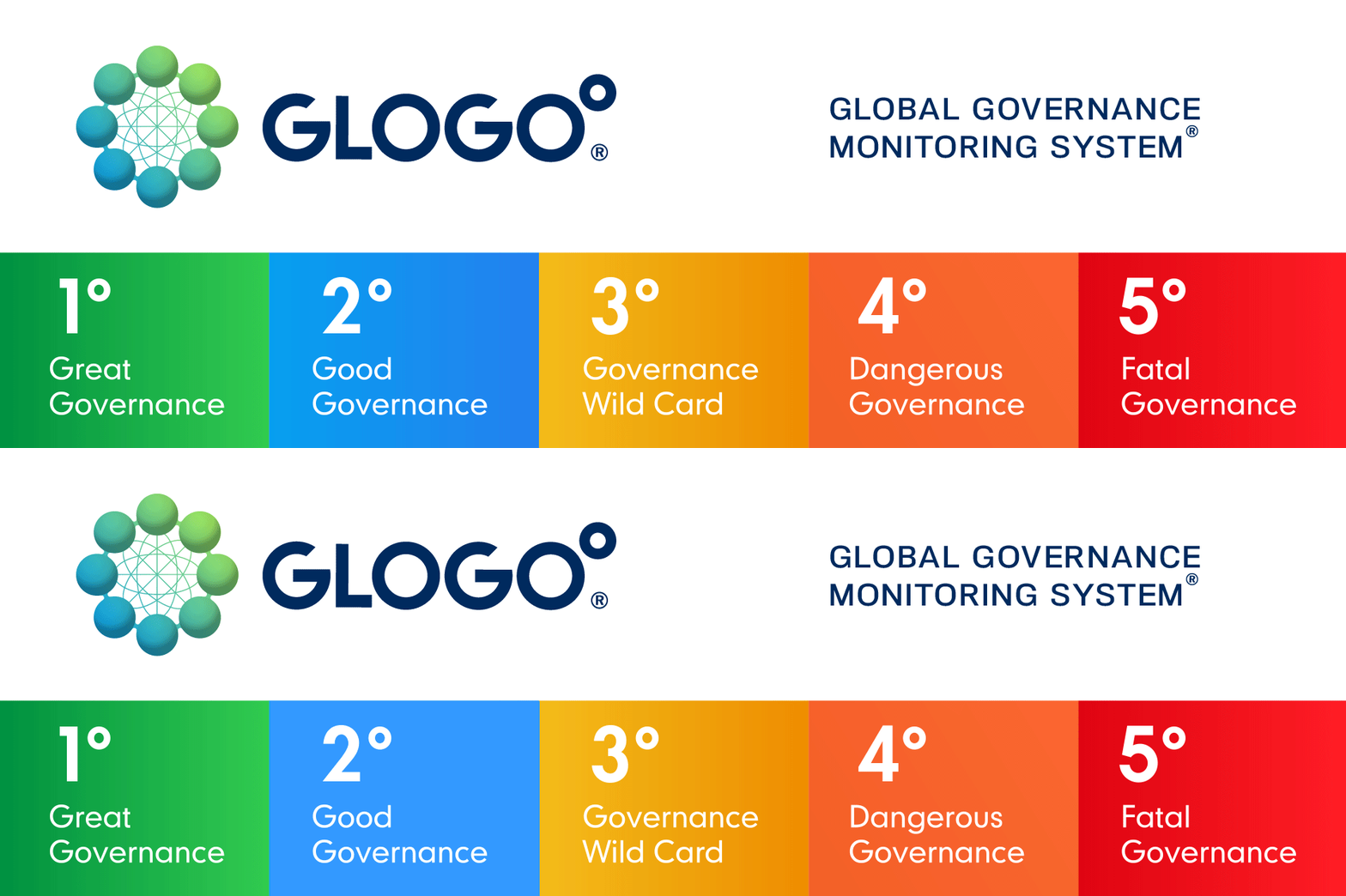
GLOGO® ALERT | LEVEL 2 | GOOD GOVERNANCE
Global Area: Humanitarian Affairs.
Sub areas: Homelessness Solutions
By Nicolas De Santis Chief Editor GLOGO®
ALERT SUMMARY
Through the GLOGO® Global Governance Monitoring System®, Gold Mercury monitors how global events, leadership decisions, public policies and institutional effectiveness contribute to positive or negative global and planetary futures. The City of Los Angeles' Inside Safe initiative represents a Level 2 – Good Governance case study, demonstrating how visionary public policy, decisive leadership and cross-sector collaboration can significantly reduce homelessness, restore public spaces and rebuild confidence in urban governance. As one of the most closely watched urban governance turnarounds in North America, the programme shows how complex social challenges can be addressed through coordinated action and measurable outcomes. While long-term challenges remain, it provides a valuable and replicable model of how effective governance can deliver tangible improvements in quality of life and urban resilience.
FULL ALERT ARTICLE
Syed used to sleep on the streets near Koreatown.
For decades, homelessness has been regarded as one of the world's most intractable urban challenges. Rising housing costs, mental health needs, substance abuse, fragmented public services and chronic shortages of affordable housing have combined to create a crisis that many cities have struggled to reverse.
Yet Los Angeles—long viewed as the epicentre of America's homelessness emergency—is beginning to demonstrate that meaningful progress is possible when political leadership, coordinated governance and housing-first strategies are aligned.
While the challenge remains immense, the city offers an important case study in how governments can move beyond managing homelessness towards systematically reducing it.
Leadership Matters
Since taking office, Mayor Karen Bass has made addressing homelessness the defining priority of her administration. On her first day in office she declared a State of Emergency on homelessness, enabling the city to accelerate decision-making, cut bureaucratic delays and mobilise resources at unprecedented speed.
Rather than treating homelessness solely as a law enforcement issue, the administration adopted an integrated housing-led approach that combines emergency intervention with long-term pathways into permanent housing.
This represents an important Visionary Governance lesson: complex social problems rarely yield to single-policy solutions. They require coordinated action across multiple institutions, actors and sectors.
Mayor Karen Bass discusses the Inside Safe initiative, which in its first year helped bring more than 21,000 Angelenos indoors, connecting people experiencing homelessness with interim housing, support services and pathways to permanent housing.
Inside Safe: A New Operating Model
At the centre of Los Angeles' strategy is Inside Safe, a city-wide programme designed to move people voluntarily from encampments into interim housing while providing intensive case management and support services.
Instead of simply clearing encampments, multidisciplinary outreach teams work directly with individuals to understand their circumstances, connect them with healthcare and social services, and transition them into motel rooms or other interim accommodation while permanent housing is secured. The programme also aims to prevent cleared encampments from immediately returning through sustained engagement and neighbourhood coordination.
By early 2026, Inside Safe had become a major component of Los Angeles' broader homelessness strategy, addressing encampments across every City Council district while contributing to thousands of people being brought indoors. City officials report that Los Angeles has experienced two consecutive years of reductions in street homelessness, reversing a decades-long upward trend.
Beyond Encampment Clearance
One of the most important lessons from Los Angeles is that successful homelessness policy cannot simply be measured by how many tents disappear.
The real measure of success is whether people remain housed, receive appropriate healthcare, rebuild stability and eventually transition into permanent homes.
That requires sustained investment in case management, behavioural health services, employment support and housing production.
While critics continue to debate programme costs, long-term housing outcomes and scalability, the shift towards coordinated, housing-first interventions represents a significant departure from previous approaches that often cycled people between streets, shelters and emergency services. The Los Angeles experience demonstrates that reducing homelessness requires treating people as individuals with complex needs rather than simply as occupants of public space.
Gold Mercury Case Study: Learning From Lived Experience
At Gold Mercury, we believe that effective public policy must be informed not only by data, but also by the lived experiences of those directly affected.
An excellent example is HOMEBASE's report, In Their Own Words: Californians' Journeys From Encampments to Housing, which draws on more than 100 interviews across four California communities with people experiencing homelessness, service providers and public officials. The study identifies practical lessons on what enables successful transitions from encampments into housing, as well as the barriers that continue to prevent lasting stability.
Gold Mercury regards this report as an important case study in human-centred governance because it demonstrates that durable solutions emerge when policy is designed around the experiences, needs and aspirations of the people it seeks to serve.
The report reinforces several principles that are increasingly evident in Los Angeles:
Housing must be paired with comprehensive support services.
Trust-building through consistent outreach is essential.
Cross-agency coordination significantly improves outcomes.
Long-term success depends on pathways to permanent housing rather than temporary shelter alone.
A Governance Challenge, Not Just a Housing Challenge
Homelessness is often described as a housing crisis. In reality, it is also a governance challenge.
It requires governments to coordinate health systems, housing authorities, social services, mental health providers, law enforcement, community organisations and private-sector partners around a common mission.
Los Angeles illustrates how political leadership, institutional coordination and operational innovation can begin to reverse even deeply entrenched social problems. Although significant challenges remain—including expanding affordable housing supply, improving long-term housing retention and ensuring financial sustainability—the city's recent experience suggests that progress is achievable when governments focus on integrated, human-centred solutions.
For cities around the world confronting similar crises, the lesson is clear: solving homelessness is not about a single programme. It is about building governance systems capable of moving people from crisis to stability with dignity, coordination and sustained commitment.
At Gold Mercury, we believe these are precisely the kinds of Visionary Governance innovations that will use systems thinking and city-wide coalitions to define more resilient and compassionate societies in the decades ahead.
Kevin used to sleep on the streets in the Valley. Hear from Angelenos personally impacted by Inside Safe
“Los Angeles is demonstrating that even the most entrenched social challenges can be addressed through Visionary Governance. The transformation seen in places such as Hollywood and Venice shows what becomes possible when governments replace fragmented responses with coordinated leadership, rapid action and human-centred policies. Homelessness is not an inevitable feature of modern cities—it is a city wide social governance challenge that can be solved when political will, institutional collaboration and long-term commitment come together around a shared mission.”
About Gold Mercury
Gold Mercury® is the global think tank for Visionary Governance® and Future Worldbuilding®, helping governments, international organisations and business leaders anticipate change and design solutions to the world's most complex challenges. Through research, strategic intelligence and policy analysis, Gold Mercury identifies innovative governance models and real-world case studies that advance peace, prosperity and sustainable human development. Since 1961, Gold Mercury has recognised outstanding leadership through the prestigious Gold Mercury Awards®, honouring individuals and organisations whose vision and actions have made a lasting contribution to humanity.
About GLOGO® - The Global Governance Monitoring System®
The GLOGO® Global Governance Monitoring System® is Gold Mercury's proprietary intelligence framework for monitoring and analysing the state of global governance. It evaluates developments across eight interconnected governance domains, identifying risks, opportunities and emerging trends that shape humanity's future. By classifying governance outcomes across different performance levels, GLOGO® provides governments, businesses and institutions with strategic insights to anticipate change, assess policy effectiveness and support better long-term decision-making.